
By: Ahmed Al‑Qorashi
* President of SEYAJ
Childhood in #Yemen is no longer a mere humanitarian file stalled in the corridors of international organizations; it has turned into a “ticking time bomb” threatening Yemen’s national security and the stability of the wider region.
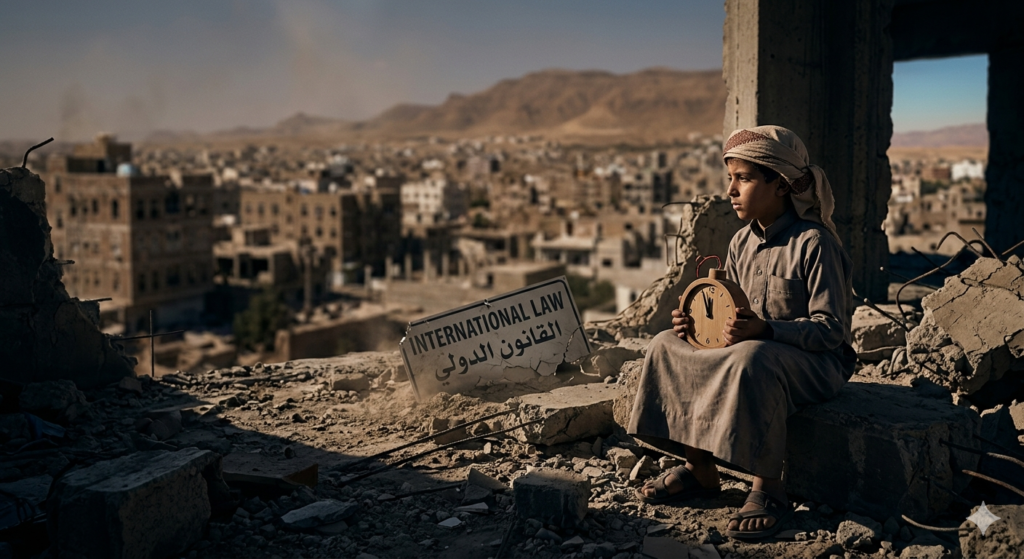
The current landscape of child rights transcends a protection crisis to become a grave indicator of structural collapse within state institutions and the disintegration of the social fabric—fueled by the systematic entrenchment of impunity, which has shifted from an exception to a sustained norm.
Despite the existence of a national legislative framework and Yemen’s ratification of international child rights conventions, the gap between law and practice has become vast.
Political, military, and security fragmentation, compounded by severe economic collapse that has driven poverty rates above 80 percent and displaced millions internally and abroad, has dismantled institutions of justice, protection, and care, leaving no unified judicial reference.
This “legislative and protective fragmentation” has created fertile ground for impunity, where criminal accountability for crimes against children is absent—whether grave violations such as forced recruitment, killing and maiming, sexual exploitation, physical and psychological violence, or maltreatment within family and community.
The result is a reality in which crimes against children appear to carry no consequences.
Child protection institutions have not been spared the impact of conflict.
Governmental bodies have been paralyzed by budgetary collapse and the suspension of specialized staff. Civil society organizations—once relied upon to fill the gap—suffer acute depletion of financial and human resources, while many have been drawn into partisan alignments by warring parties.
Some have even turned into “fortresses and shields” protecting perpetrators instead of holding them accountable, shrinking the space for human rights work and undermining monitoring, documentation, and intervention capacities.
We are now facing a comprehensive breakdown of the protection system, leaving children exposed to their fate without legal or social safeguards.
We affirm that overlooking child rights violations and failing to prosecute perpetrators is not merely a moral failure but a strategic existential threat, producing:
Fueling armed conflicts:
The absence of accountability for child recruitment ensures their transformation into perpetual fuel for wars, sustaining cycles of violence for decades.
#Childhood as a cradle for organized crime:
Children deprived of protection and education, and witnessing impunity, become vulnerable to recruitment by criminal gangs and extremist networks, generating generations burdened with crises.
Regional destabilization:
The collapse of childhood in Yemen exports security and social crises beyond national borders, imposing long‑term burdens on the stability of the Arabian Peninsula and the Gulf.
In light of the above, and consistent with our calls for over 18 years, we reiterate the imperative of establishing and activating national accountability strategies and mechanisms.
A safe exit from this dark tunnel requires recognition that child protection is a security priority before being a humanitarian one.
Genuine stability in Yemen and the region cannot be achieved without enforcing accountability for perpetrators of crimes against children, regardless of political or military affiliation.
This obliges the Yemeni state, together with international and regional actors, to unify child protection efforts beyond political rivalries, and to support national judiciary institutions, independent civil society organizations, and governmental care institutions in fulfilling their role in law enforcement.
The continuation of widespread crimes against children without deterrent punishment, and without genuine care for survivors of violence, is an investment in tomorrow’s disasters. The Yemeni child whose rights are violated today without accountability for the offender will not grow into a responsible citizen tomorrow; rather, he will remain a perpetual project of destabilization at national, regional, and international levels—unless conscience and law intervene to break the cycle of impunity.