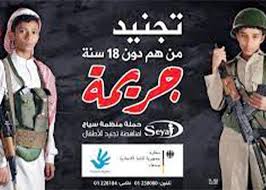
The head of the “Siyaj” organization told “Yemen Monitor”: Child recruitment in Yemen increased by 500 percent in 2015.
غير مصنف 10 June 2016

The head of the “Siyaj” organization told “Yemen Monitor”: Child recruitment in Yemen increased ...

* Quoted from Yemen Monitor website / Sana'a / Special Ahmed Al-Qurashi, head of the Seyaj Organization for Child Protection, stated that the recruitment of children…

The head of the “Siyaj” organization told “Yemen Monitor”: Child recruitment in Yemen increased by 500 percent in 2015.
10 June 2016 غير مصنف motive

* Quoted from Yemen Monitor website / Sana’a / Special

Ahmed Al-Qurashi, head of the Seyaj Organization for Child Protection, stated that the recruitment of children in Yemen increased by 500 percent during 2015.

Al-Qurashi added in a special statement to “Yemen Monitor”: There is no doubt that the recruitment of children and their involvement in armed conflicts is a grave crime and a violation of international humanitarian law, human rights, and conventions on the rights of the child. This is a crime upon which all agree. International conventions are a result of the significant risks stemming from this practice, primarily the killing of children, as well as mutilation, injuries, disabilities, psychological trauma, and the denial of their right to education and school attendance. There are also strategic economic considerations.

More… Children Yemen… Recruits in the Death Pits

Regarding the reasons for child recruitment, Al-Qurashi pointed out that the lack of legislation, a societal culture that favors and encourages bearing arms, tribal wars and vendettas, and the tribal duty borne by the majority of society are the most significant problems that have led to this becoming a widespread phenomenon.

Regarding the reasons for the increase in recruitment last year, he said: “There has been a very large and noticeable increase in the involvement of children in armed conflicts in Yemen, especially since 2015, where the rate has risen by more than five hundred percent compared to previous years, as a result of the expansion of the areas that witnessed war and armed conflicts to a greater extent than in previous periods.”

He added on the same topic: “Likewise, the high rates of poverty, unemployment, and displacement resulting from the war and armed conflict Also, the collapse of state institutions, the lack of controls over such actions, and the absence of activity from civil society organizations.

Al-Qurashi pointed out that the child welfare organization he heads presented its vision, particularly since 2011. There was a response from the Yemeni government and presidency in 2013 and 2014, with the signing of an agreement between the United Nations and the Yemeni government, as well as the Yemeni government’s ratification of the Paris Principles. This was a result of the government’s genuine intentions at the time to implement the necessary measures and solutions to mitigate the problem. Unfortunately, these initiatives and procedures were thwarted prematurely, before they could even begin.

Al-Qurashi explained that the vision was based on “the existence of national legislation, awareness campaigns, controls and standards for joining the armed forces, and accountability for those who recruit children, whether they are tribal sheikhs, armed groups, or forces.” Regular.”

A United Nations report released last week accused the Houthis of widespread recruitment of children and sending them to the front lines, noting that the number of child soldiers in Yemen had increased nearly fivefold compared to 2014. The report documented 762 cases of recruitment, the majority of which were attributed to the Houthis.

شارك رأيك

نرحب برأيك وتعليقك على هذا المقال. سيتم نشر التعليق بعد المراجعة.

بيانات المقال

التاريخ 10 June 2016
التصنيف غير مصنف
الكاتب motive

مقالات ذات صلة

عرض كل الأخبار
Conservation policy
غير مصنف
24 May 2026

Conservation policy

The safeguarding policy of the Siyaj Organization for Child Protection – Arabic This policy was developed based on Siyaj Organization’s belief in the importance of creating a safe working environment for all directly related parties, including direct and indirect beneficiaries of its humanitarian services, targeted groups, partners, service providers, volunteers, employees, and up to the<a href="https://seyaj.org/en/conservation-policy/">Continue reading <span class="sr-only">"Conservation policy"</span></a>

An assessment reveals that the majority of local and national humanitarian organizations lack “preservation” policies and procedures.
غير مصنف
24 May 2026

An assessment reveals that the majority of local and national humanitarian...

A recent assessment revealed that humanitarian organizations lack policies and procedures that protect their staff and beneficiaries from harm during the delivery of humanitarian assistance. According to the assessment results conducted by Siyaj Organization for Child Protection in cooperation with Tamkeen Youth Foundation, aimed at identifying the needs of civil society organizations working in the<a href="https://seyaj.org/en/an-assessment-reveals-that-the-majority-of-local-and-national-humanitarian-organizations-lack-preservation-policies-and-procedures/">Continue reading <span class="sr-only">"An assessment reveals that the majority of local and national humanitarian organizations lack “preservation” policies and procedures."</span></a>

An assessment reveals that the majority of local and national humanitarian organizations lack “preservation” policies and procedures.
غير مصنف
24 May 2026

An assessment reveals that the majority of local and national humanitarian...

A recent assessment revealed that humanitarian organizations lack policies and procedures that protect their staff and beneficiaries from harm during the delivery of humanitarian assistance. According to the assessment results conducted by Siyaj Organization for Child Protection in cooperation with Tamkeen Youth Foundation, aimed at identifying the needs of civil society organizations working in the<a href="https://seyaj.org/en/an-assessment-reveals-that-the-majority-of-local-and-national-humanitarian-organizations-lack-preservation-policies-and-procedures-2-2/">Continue reading <span class="sr-only">"An assessment reveals that the majority of local and national humanitarian organizations lack “preservation” policies and procedures."</span></a>