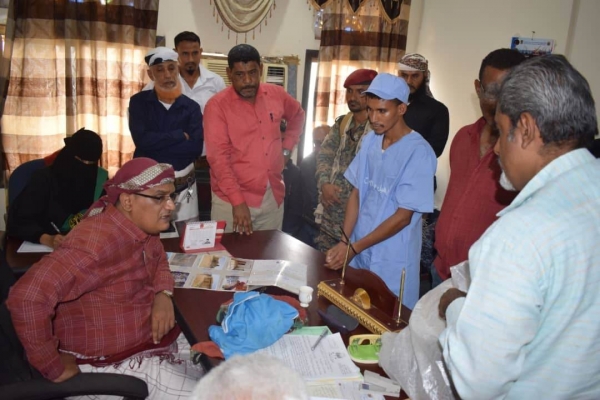


Today, the Seyaj Organization launched the second phase of its project to combat the recruitment and use of children in armed conflicts. At the inauguration ceremony for the project, implemented by Siyaj in cooperation with the Ministry of Defense and with the support of the Embassy of the Federal Republic of Germany in Sana’a, Brigadier General Ahmed Mohsen Salem Al-Yafei, Director of Military Intelligence at the Yemeni Ministry of Defense, affirmed that the Minister of Defense had issued a series of decisions and directives aimed at regulating operations within the armed forces and security services. These directives are intended to prioritize the well-being of children and reduce their recruitment into government forces in the future. In his address on behalf of the Minister of Defense, Brigadier General Al-Yafei stated that President Abd Rabbo Mansour Hadi’s decision on November 27th to prohibit the recruitment of children reflects the state’s new approach to this serious issue. He emphasized that child recruitment is a crime and a violation of Yemeni and international laws, underscoring that the state, the government, Yemeni society, and families are all opposed to the recruitment of children and their involvement in armed conflicts, whether within the armed forces, armed militias, or tribal groups. Brigadier General Al-Yafai pointed to the efforts of the Ministry of Defense in combating the smuggling of children to neighboring countries through the border guards and preventing the granting of licenses to carry weapons to those under the age of 18, in addition to its cooperation with local and international civil organizations, including the Siyaj organization, in order to develop an integrated action plan to remove children from conflict zones and reintegrate them into civilian life by rehabilitating them psychologically and educationally and creating job opportunities for them.
The Military Intelligence Commander praised the activities carried out by the Seyaj Organization in addressing the crimes and violations committed against Yemeni children, especially those in areas of armed conflict, where Seyaj has succeeded in shaping national and international public opinion on this issue.
For his part, the head of the Siyaj Organization, Ahmed Al-Qurashi, praised President Abd Rabbo Mansour Hadi’s decision to ban the recruitment of children, which comes as a culmination of the efforts that Siyaj has undertaken to combat this serious violation since 2009. While thanking the Ministry of Defense, represented by Minister Major General Mohammed Nasser Ahmed, for its cooperation and partnership with Siyaj in implementing this campaign, Al-Qurashi pointed to the difficulties and challenges it faced, most notably the lack of national legislation criminalizing these practices and punishing their perpetrators, and the low level of awareness among the community, many government officials, and tribal leaders. He emphasized that Siyaj is undertaking this work out of a sense of national and humanitarian duty. He called for a review of legislation with stricter measures against perpetrators of such practices, the development of a comprehensive national plan for the demobilization and rehabilitation of child victims, and the implementation of measures to prevent children from joining government forces. He also stressed the need to curb the activities of armed groups, militias, and tribes, and to activate the role of media, mosques, and civil society organizations in raising awareness about the dangers of child recruitment and their involvement in armed conflicts. He emphasized that this phenomenon is one of the causes of violence that fuels underdevelopment and illiteracy, and that children are the primary fuel when drawn into armed conflicts, whether in regular or irregular forces. Al-Qurashi expressed the organization’s gratitude for the German government’s support in many aspects of development, human rights, and political, economic, and social stability, which have become increasingly critical recently. He also commended the cooperation of the relevant authorities in the Government of National Accord, represented by the Ministries of Human Rights and Defense. The Ministry of Interior, the media, and local authorities in the eight governorates where the project is being implemented (Sana’a Governorate, Sana’a Governorate, Aden Governorate, Taiz, Ibb, Hajjah, Dhamar, and Amran). The launch was attended by Ms. Nour Al-Kassadi from the UNICEF office in Yemen, His Excellency Ambassador Ashraf Aqel, Ambassador of the Arab Republic of Egypt, representatives from the embassies of the United States, Britain, Germany, and France, Brigadier General Ali Ghaleb Al-Harazi, Deputy Director of the Moral Guidance Department at the Ministry of Defense, and representatives from several human rights organizations and national and international media outlets. Siyaj Organization – Sana’a – January 15, 2013